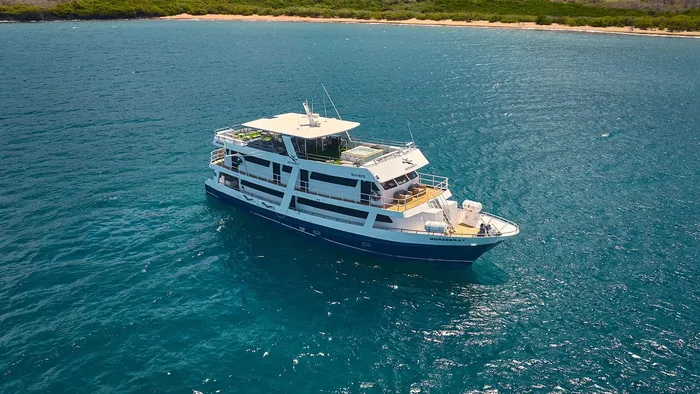
Ash: Yazmany, you've been our Galapagos guide aboard the Montserrat, and you're a regular guide aboard the Hermes and Montserrat Galapagos cruise. How long have you been a Galapagos guide?Yazmany: Good morning. I got my license in the Galapagos Island 24 years ago, 2002.Ash: And where were you born and raised?Yazmany: I was born in the Santa Cruz Island. So, well, I live in Santa Cruz Island, but I was born on San Cristobal Island because the hospital was working 43 years ago, only on that island. That's why I was born there.Ash: Was nature important to you growing up?Yazmany: Definitely yes, because you grow with all the nature around. So my house was just next to the ocean, and the school, all the time, we got environmental education, and basically everything around you is nature. Nature, nature, nature.Ash: Was there a specific moment, a place, or a person that influenced your choice to become a guide on the Galapagos?Yazmany: I grew up, I told you already, with nature around. I was very happy when I got the opportunity to be a volunteer at the Galapagos National Park, going to the breeding center, helping cleaning the corrals of the giant tortoises, learning about nature, about the preservation of the Galapagos Island. Helping, going around, killing introduced species. So, and then I decide to be a naturalist. I decide to be sharing this beautiful life, the experience that I got with all the visitors here, so...Ash: Did your friends and family understand your choice of career?Yazmany: I got the opportunity. I feel very lucky because my parents, they were working at cruises like this boat, like Montserrat. So 35 years ago, I think, was my first time to get a cruise. So my father was the captain at that time. My mother was the chef. So, and then I got the opportunity to be with tourists. I could see the naturalists taking the guests to the island, explaining everything about nature, speaking other languages. So then, one of my wishes was to be a naturalist. I want to do that, to take the guests for snorkeling, to walk, to teach them, to show them the island. So yeah, I grew up in contact with nature and also the tourism activity because my parents.Ash: Right. Can you walk us through what it takes to become a guide on the Galapagos Islands?Yazmany: There are different things, different ways to get your license to be a naturalist. There are some colleagues that they got their license because they were working for more than 20 years at the National Park as park rangers, working hard, hard. So many, many years. And in the end, they got a license from the Galapagos National Park. But for that, I'm talking about 40 years ago. Just people they want because passengers were starting to visit the islands. Was not possible to send them by their own to explore the islands. So then the Galapagos National Park was looking for people, "Hey, do you want to be a naturalist? Please tell them the National Park rules. Go with them, and then everybody can follow the rules and respect nature." Everything was starting like that, but then it was necessary a formation. So we need to be a naturalist. We have an exam with 1,000 questions. Everybody want to be a naturalist because it's beautiful to be just like on holidays all the time, taking cruises, going to snorkeling, walking in contact with nature. But you have a very difficult exam with thousands, hundreds of questions, and then you need to be really good doing that. If you can pass it, after 80%, you can be part of the group to get the course or the formation to be a naturalist. It's not that easy. It's not like, "Oh, okay, I want to be a naturalist. That's it." It's complicated the last 20 years.Ash: So was that the hardest part?Yazmany: For everybody, yeah, the exam. You have many topics to study about biology, geology, about everything, and then I don't want to be exaggerated with this, but normally 500 people are going to do this exam, and only 50, 45 people can pass it.Ash: Did anything surprise you about the training to be a guide?Yazmany: During the course?Ash: During your whole guiding training.Yazmany: Sometime people, because I know the wildlife, I know the species here, but sometime people are different. It's a little bit complicated because sometime you have a group, you're guiding a group with different kind of people, different nationalities, different ages. They are thinking different. Sometime we have real nature lovers, happy to be walking, snorkeling, and sometime we have some guests, they came because Galapagos is one of the famous destinations to go, and they are boring and grumpy all the time because they don't like the condition of the islands. So this surprised me, and it's very difficult to manage that because they are very grumpy sometimes on the island. Like, "Ah, this is too hot. There is no breeze here, no shade, there's no service." So then you need to be kind to talk with them, to say, "Okay, this is nature. We don't want to change too much the island because the wildlife," and they are very disappointed. And this is one of my experience and difficulty that I got during my job. So it's difficult to manage that. So people than species.Ash: So in your years guiding, has a guest ever taught you anything about the Galapagos that you didn't know, being born and raised here, being a guide for years?Yazmany: Of course. Definitely, yes. So because you know everything about the islands, but you are not an expert, for example, about genetics, things like that. But sometimes you are meeting guests, their whole life, professors working with the species, and they know a lot, or sometimes geologists, and then it's when you are getting the opportunity to learn more from them. Because the last two decades, you can get a lot of information online, you are reading papers, many things. But when you are with guests that their whole life, so more than 50 years, working with specific species, for example, mammals or fish, or birds, or rocks, geologists, you can learn. And then it's the opportunity that you have a chance to ask, and they are happy to share the information with you. Recently, I got that opportunity this year, 2026, January 21st, I got a group of geologists coming, retired geologists, professors, and then finally I could learn something that was not clear about the tuff, about the ash on the basalt. So why? Well, I could learn. So I'm glad when I'm meeting professional people, experts with something, because it's the opportunity that you have to learn more and to be more clear, and then you can share this information with the guests in the future.Ash: Do you notice when guests really connect to the Galapagos? Is there something that they say or do that shows you that the islands are going to leave an impression?Yazmany: Definitely, yes. We are naturalist guides, but also when you are working many, many years, also it's possible for me to say an expert to recognize people and the connection they are getting with the islands. So you can feel that, you can see that when they are looking something, when they are looking at the ocean, at the animals, and the expression that you can see at. So yeah, I can recognize that. So I'm glad. When it's something that happened, I'm helping to providing that connection because sometimes they are like, they want, but they can't. "Okay, no worries. Relax." And sometimes I'm quiet. I don't want to be talking too much on the islands. So I leave them for a while to be a little bit free under the national park rules, of course, and they can get that special connection with nature, even with everything in the islands. It's really nice. So I can see that. I really like that.Ash: What's the strangest or most unexpected thing that's happened on a trip?Yazmany: To be honest, all the time we're getting surprises in Galapagos. That's why always I am ready with my phone to take pictures, to record, to make a video, even in the water. And always you can see something new. Always. Recently, for example, the snake in the water. In the last seven months, I could see that big shark in the water. Sometimes you can see killer whales, octopus doing something, playing, a penguin eating something. All the time you're getting surprises. That's why always I am taking my cameras because always you have something new to see. It's really nice. So the Galapagos are magical. My whole life, so 43 years in Galapagos, always, every single day, you can see something new, something unique.Ash: Aside from the island you were born on, do you have a favorite island or islands? And if so, why?Yazmany: To be honest, I love all of them because the islands are different. So that's why if you are coming to Galapagos, if you have many days, it's much better because you can see more and learn more about the Galapagos Island. Because no favorite because from island to island, there are different things to see. Depends. If you like marine life, I'm talking about when you are snorkeling, sharks, sea lions, penguins. So there are some islands with some specific species. So I don't have any favorite. All of them are my favorite. So the islands are different. The animals, the species, they were shared in the islands. So there are so many species at the north part, at the south part, the east part, the western part. So it's really important if you're planning to visit the islands, to make sure what things you want to see in the islands, because the islands are completely different. I don't have any favorite. All of them are my favorite because there are different things to see and to do.Ash: Is there an animal or a moment or island on the Galapagos that, even after all these years, still gets you excited?Yazmany: It's a similar answer, because I love sea lions, because I really like to call them sea dogs, because they love to play with you, make you happy. They are looking at you, swimming around you, playing with you. So that is really nice. That make me glad, make me happy, and also all of the guests are happy all the time with them. But of course, when you can see a giant manta ray in the water, or you can see sharks, it doesn't matter the species, sharks in the water, you're feeling the adrenaline when you can see that. And all the small details, sometimes an octopus or marine iguana underwater, or penguins swimming by us. So, it's complicated to provide an answer about it.Ash: If you could make sure that guests knew something before their visit to the Galapagos, is there anything that you'd like them to know?Yazmany: Weather could be. Just it's important to know about the Galapagos Island. Basically, it's something unique to visit. Everything is in the wild and magical, and to be prepared and ready for that. So with good shoes, for example, a jacket, because sometimes there are some guests coming and they are unprepared. They say, "Ah, nobody told me about this. I didn't know that. I know that it's the hotter time in Galapagos, but it's raining." Or sometime when they're coming during the dry season, they are expecting everything dry, but it's cloudy and misty. And then they are a little bit disappointed about it. They say, "Oh, yeah, suppose that is the dry season." Yeah, everything is dry, so the vegetation, no water, no heavy rain, but it's cold, for example. And the other thing is, that is important to know because they can enjoy when they are here, because sometimes they are unprepared and they are here very disappointed about it. "Ah, I didn't bring this. I don't have water shoes. I don't have good shoes for walking. I brought only flip-flop. I was expecting just beaches with animals around." So I think there are many details that the guests need to know about the islands. Weather, about the island that are national park, that everything is in the wild, and to be prepared for that. So it's important to get information before to visit.Ash: So obviously you're very familiar with the islands. Has the ecosystem changed in the time that you've been here that you can notice?Yazmany: There are some good things and some negative things. About the good things is about the preservation of the Galapagos Island. Everything is under a good organization. The priority for our authorities to the Galapagos National Park is the preservation of the natural ecosystem of the Galapagos Island. Everything is under control. The cruises, the day tours, all the activities that we have in the Galapagos Island, fishing activity, the tourism activity, everything is under a good control. And next to this, in other hands, the preservation. Every day, locals, park rangers, people are helping, trying to work, trying to help with, just in town, for example, with the classification of the trash, the garbage, plastic, paper, recycling, following the rules. Park rangers working every day around trying to kill introduced species. Reforestation. So, the activity that we are doing every day is much better. The last 20, 30 years is much and much better. That is about the good things. So I told you already, I was born in the Galapagos Island. My whole life in contact with nature, cruises, fishing. Part of my life also, I was a fisherman, taking boat for fishing, diving, free diving, fishing snappers, octopus, lobster, sea cucumbers, and now we have more control for those activities. We have long periods that we are not fishing, trying to keep the species okay. So everything is going much better according with this community, Galapagos National Park, and the activities that we are doing here. Everything is going good.Ash: What about the negative things?Yazmany: Well, now this is all over the world they're saying the global warming. We are getting more water here. So the last 20 years, we're getting extra centimeter of water and some habitats are disappearing. For example, I know the important beaches in Galapagos where the sea turtles are nesting, but with much water, the nesting areas are disappearing. Too much water covering the beaches, the dunes. More water, so the sea turtles, they don't have enough area for nesting. This is one of the negative things that I can see in the Galapagos Island and the natural ecosystems. El Nino, when all the time we are getting Nino, I'm not talking about El Nino, I'm talking about extra water, more water, extra high tide, more meters, destroying natural ecosystem, basically the nesting area for the green sea turtles, because we have a really good population of sea turtles nesting in Galapagos. Approximately 10,000 sea turtles nesting from year to year, but now they have a limitation at the nesting areas because too much water. That is about the negative thing that I could see in Galapagos.Ash: Are there any benefits to choosing, say, a cruise-based Galapagos experience or a land-based hotel experience on the islands?Yazmany: Good questions. About this, it's a very interesting topic because all the time, the community authorities are talking about it, because people, the cruises, they say, "Oh, that is the best option in Galapagos. Much better preservation. Everything is much better, is under control." And then the community, the people in town, they are working on day tours, land-based. They said, "Ah, everything is a cruise boat. What about us?" My personal opinion, because I am on cruises, I am on day tours, land-based, both are okay, because everything is under control. All the time there are naturalists on board. We're following the national park rules. Doing exactly the same thing could be possible to say that, the same thing, because we're going to some islands to do the same thing that you're doing in a cruise boat. You're walking on the island, you are snorkeling around the island, you are getting lunch on board, but you're going back to the port to sleep on port at the different hotels. That is nice for the local economy, because you're getting dinner in town, you're buying a souvenir in town or buying an ice cream. Good for the locals. The pioneer people that came to Galapagos, they have Airbnbs or guesthouse hotels. It's really good. Cruises, the same thing. Some people, they like live on board and to not be in town. Some people, they like to share with the locals in town. So both activities are good. The only thing that the locals need to learn is the three inhabited islands, is to work together to provide a better service. Because to be honest, sometimes the competition is just to be cheaper than the other. But if you are cheaper, you cannot provide a better service. Cruises, the standard is quality, expensive, not because the owner of the boats, the companies, they want to be expensive. Just because they want to provide a good service, the best service, and everything is expensive. In town, day tours, some specific tours, they are just thinking to work and to be cheaper than the others, and then it's when you have a less service. I'm talking about you cannot provide a good food. The snorkel equipment is not the best one because it's very expensive, but all over the world it's expensive, masks, snorkel, fins, wetsuit. But if you have a regular and good price, you can provide good equipment to the guests. Good wetsuit, good fins, good equipment, good food, snacks, and everything. So basically, about the activity, the tourism activity, cruises, they can provide a better service because the things to do on the island is exactly the same. Naturalists, rules, but the facilities and the service is much better on board cruises. That's why more expensive, but it's according. Better service, a little bit more expensive. Land-based is a little bit cheaper, but sometimes the quality is not the best one.Ash: So can you offer any tips from a guest's perspective on choosing, say, a good cruise versus having a worse experience aboard on the Galapagos?Yazmany: I think you are not coming to Galapagos... Galapagos is not a destination to go constantly to go. And it's very expensive destination. It's far away normally for the different countries that are coming here, because we have guests coming from all over the world. So it's not an easy destination to go. So I think if you are coming to Galapagos, it's much better to spend a little bit more money to get a good experience on cruises. If you have more days, it's much better because you can see more. Because one more time, we don't have an island with everything. It's necessary to explore different islands to see more. So this is my recommendation if you're planning to visit the island. Sometimes the budget is different. It's, "Oh, I want to go. I have for the flight, but not for the cruise." So and then you have also the option, the land-based, and the day tours. So it depends of the guests or the people that are planning to visit the islands.Ash: You must have guided hundreds of people in your life on the Galapagos. Is there anything that you hope that they're still thinking about until today or a year after their experience on the island?Yazmany: I think, I was guiding hundreds of people, and in my own experience, I got a really good experience because most of them, the 99% of them are nature lovers. And it made me very glad because I was guiding a family or a couple or one person today, and they are coming back five or 10 years later, or many friends from those people are coming to Galapagos. So this is a good thing because everybody are very happy, very glad. They are getting good memories and good experience after they spend the time in the Galapagos Island. And basically, this is the marketing that we have here. Just the good comments from people that have been here, when they are going back to their countries talking about the really good experience that they got. So and then more people are coming, and more constantly people are coming to here. So basically, I'm glad for that. I told you, 100%, it's possible for me to say almost 100% of the people that are coming, they are very glad. Never disappointed about the island. And then things like that make me glad as well, because sometimes when some guests, they didn't know too much about the island. After a few days here, they could learn about it, and they were changing their mind and said, "Okay, Yazmany, I didn't expect that. I was unprepared for this, but now I know. Thank you. It's magical. I really love that. My family will be in love with that, and then my friends, my neighbor, and everybody." So that is it.Ash: Fantastic. Well, thank you very much, Yazmany, for your time.Yazmany: Thank you. Thank you very much for your time. Thank you for coming.
Read full transcript